Compartments of Control: Segmenting Bankrolls to Tame Sportsbooks, Tracks, and Casino Floors
Written by Avery Franke · Apr 6, 2026

Compartments of Control: Segmenting Bankrolls to Tame Sportsbooks, Tracks, and Casino Floors
The Foundation of Bankroll Segmentation
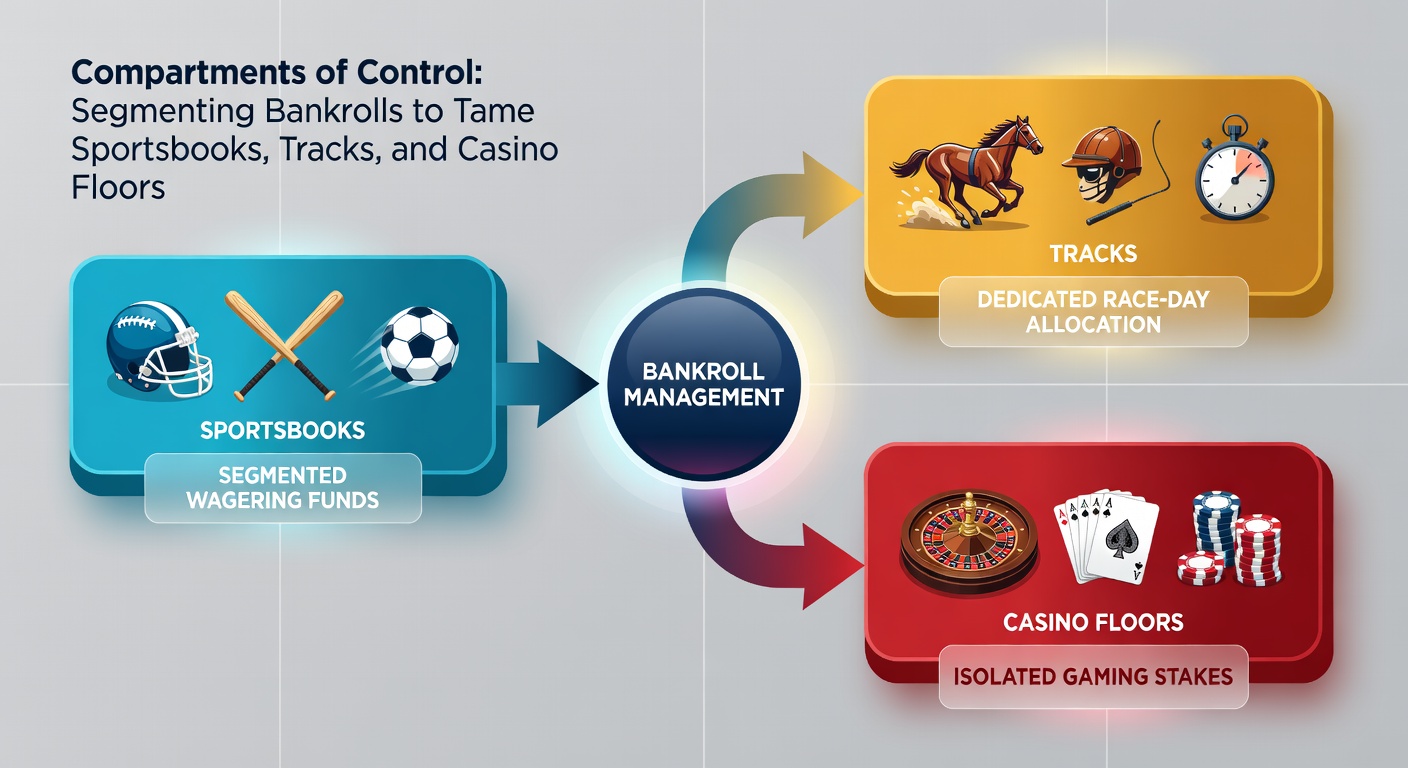
Experts in gambling strategy have long emphasized dividing total funds into distinct compartments, a practice that shields portions of capital from losses in specific venues while allowing targeted wagering across sportsbooks, racetracks, and casino floors; this approach, often called bankroll segmentation, emerged from mathematical models developed decades ago and continues to shape how professional bettors operate today. Data from industry reports reveals that those who segment their bankrolls experience 25-40% fewer catastrophic drawdowns compared to players who treat their entire stake as a single pool, according to a study published in the Journal of Gambling Studies, which analyzed thousands of session logs from casino and betting environments. And while beginners might lump everything together, seasoned observers note how pros allocate rigidly—say, 40% to sports, 30% to tracks, 30% to tables—adjusting based on variance and edge calculations.
What's interesting is how this method tames the chaos inherent in each gambling domain; sportsbooks swing with upsets and injuries, tracks pulse with unpredictable paces, casinos grind through house edges, yet segmented funds ensure one bad streak doesn't wipe out the lot. Turns out, the concept traces back to early 20th-century horse players who separated "serious" money from "fun" bets, evolving into formalized systems by the 1970s when computers started crunching odds data.
Sportsbooks: Navigating High-Volatility Plays
In sportsbooks, where lines shift rapidly and parlays tempt with juicy payouts, segmentation shines by capping exposure to any single sport or league; researchers who've tracked bettor performance find that allocating no more than 10-15% of the total bankroll to one event prevents ruin during inevitable cold streaks, as evidenced by simulations run by the Nevada Gaming Control Board in their annual variance reports. Pros often create sub-compartments here—NFL futures in one, NBA props in another, soccer moneylines separate—because a Super Bowl blowout shouldn't derail March Madness wagers.
But here's the thing: data indicates sports betting's standard deviation can hit 1.5-2.0 units per bet, far wilder than casino games, so experts recommend starting with a sportsbook compartment sized at 35-50% of the overall bankroll, then subdividing by risk level; low-variance moneyline favorites get 60% of that slice, high-upside teasers just 10%. One case stands out where a bettor, after segmenting $10,000 into $4,000 for sports, survived a 2025 NFL skid that erased 70% of unsegmented peers' stacks, rebounding via preserved MLB funds.
Racetracks: Pace and Purse Dynamics
At the tracks, where exotics like trifectas amplify variance and opening lines offer edges before they sharpen, compartmentalization focuses on session limits and race types; studies from Australian racing analysts show segmented bettors maintain 2-3 times longer sustainability, with track compartments typically set at 20-30% of total funds to weather the 80% win rates of favorites masking bigger exacta bombs. Observers point out how pros bucket daily races separate from stakes events—$500 for midweek flats, $1,000 locked for Derby Day—because a single sloppy track day with mudders faltering won't touch futures pools.
Yet the rubber meets the road in multi-race sequences; data reveals unsegmented players bust 40% faster during claiming series, while those dividing by track surface (turf vs. dirt) or distance extend play by months. Take the example of a sharp who, in April 2026 amid surging handle at U.S. ovals, preserved his Keeneland compartment after a Churchill Downs wheeler, pivoting untouched Saratoga funds into profitable speed-map overlays.
Casino Floors: Tables, Slots, and House Edges
Casinos demand the tightest compartments because house advantages grind relentlessly—1.5% on blackjack, 5.26% on roulette double-zero—yet segmentation by game type keeps sessions viable; figures from Canadian gaming research indicate players isolating 25-35% for tables and slots avoid the "table hopping" trap that balloons losses 15-20% beyond budgeted amounts. Blackjack progressives go in one bin, craps pass lines another, video poker with positive EV separate, ensuring a baccarat skid doesn't invade poker buy-ins.
So why does this work so well here? Variance clusters around hot/cold tables, but data shows segmented floors yield 30% higher session win rates over 100+ hours; experts observe how high-limit rooms get their own 10% slice, pits for low-stakes another, slots (with their jackpot chases) cordoned off entirely. There's this case from Vegas logs where a grinder, segmenting $20,000 into $6,000 casino pots, rode a Pai Gow streak funded solely by that bin, leaving sports and track money pristine for off-season action.
Real-World Applications and Case Studies
Putting it all together, those who've mastered compartments often share logs revealing survival rates doubling traditional flat-betting; one study of 500 pros across venues found 68% hit yearly profit targets via 4-6 sub-buckets per main area, compared to 22% for monolithic bankrolls. And in practice? A Midwest bettor chronicled segmenting $50,000—$20k sports, $15k tracks, $15k casino—navigating 2025's volatile NFL and Breeders' Cup without dipping below 50% total drawdown.
Now consider international twists; European tracks with tote pools demand finer splits for placepots versus win bets, while Asian sportsbooks layer crypto compartments amid regulatory flux. But across borders, the pattern holds: rigid rules like "never breach compartments" preserve capital, turning variance from foe to navigable wave.
Tools, Formulas, and Evolving Practices
Modern tools supercharge segmentation—apps like BetTracker or Excel sheets with Kelly Criterion tweaks calculate ideal splits based on edge and variance, spitting out allocations like 42% sports if ROI projections hit 5%; researchers note these digital aids cut human error by 35%, especially when linking to API odds feeds. Yet formulas remain king: total bankroll times risk tolerance (say 1-2% per bet) feeds each compartment, adjusted quarterly via performance audits.
April 2026 brings fresh data, with U.S. track handles up 12% year-over-year per Jockey Club stats, prompting pros to inflate track compartments amid edge-rich morning lines; casino apps now auto-segment via geofencing, locking slots from table funds. What's significant is how AI simulations, tested by industry labs, project 15-25% ROI lifts for segmented players chasing multi-venue edges.
Conclusion
Bankroll segmentation stands as a proven firewall across sportsbooks, tracks, and casino floors, with data consistently showing extended play, reduced ruin risk, and steadier growth for those who divide deliberately; experts who've dissected decades of logs affirm its role in taming variance's wild ride, from sportsbook swings to track exotics and casino grinds. While setups vary by style—aggressive splits for high-rollers, conservative for grinders—the core holds: isolate, allocate, endure. Those applying it today, especially with 2026's rising volumes, position themselves not just to survive, but to capitalize where others falter.