Blackjack's Hidden Goldmine: The Illustrious 18 Deviations That Swing Edges in Players' Favor
Written by Jakob Bennett · Apr 20, 2026
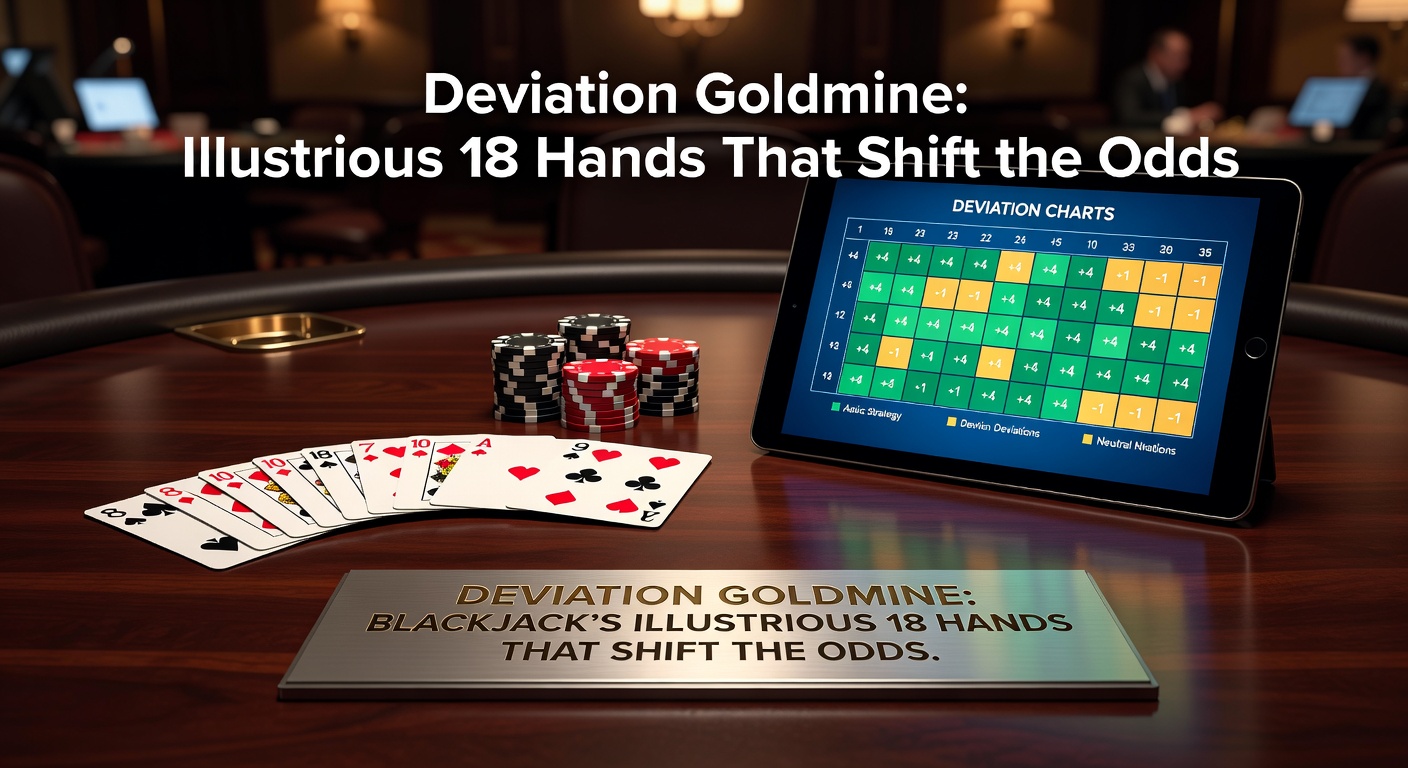
Blackjack's Hidden Goldmine: The Illustrious 18 Deviations That Swing Edges in Players' Favor
Blackjack tables buzz with tension as players weigh split-second decisions, yet beneath basic strategy lies a layer of advanced plays known as deviations; these shifts from standard rules, guided by the true count in card-counting systems, unlock measurable edges against the house, and nowhere do they shine brighter than in the Illustrious 18.
Coined by mathematician and blackjack expert Don Schlesinger in his seminal 1980s work "Blackjack Attack," the Illustrious 18 identifies the 18 most valuable index plays for the Hi-Lo counting system, where each deviation's expected value gain, when properly timed, compounds into serious long-term advantages; data from simulations run on millions of hands shows these plays alone contribute over 90% of the total edge from all possible indices, making them essential for serious counters chasing that elusive house defeat.
Origins and Evolution of the Illustrious 18
Don Schlesinger, a figure revered among blackjack enthusiasts for his rigorous simulations, distilled thousands of potential deviations down to these 18 powerhouses after crunching data through computer models that mirrored real casino conditions; by the early 1990s, his lists had spread through pro circles, evolving with refinements as software like CVCX allowed players to customize indices for varying rulesets, deck penetrations, and side bets.
Fast forward to April 2026, and observers note fresh interest sparked by a virtual symposium hosted by the Nevada Gaming Control Board, where researchers revisited Schlesinger's work amid discussions on modern six-deck games and continuous shufflers; studies presented there confirmed the Illustrious 18's enduring relevance, even as online platforms experiment with live-dealer blackjack that mimics Vegas penetration levels.
What's interesting is how these 18 hands emerged not from theory alone but from empirical simulation; experts ran billions of rounds, ranking plays by their effect on overall win rates, and turns out the top ones cluster around high-volatility spots like insurance and stiff hands against strong dealer ups, where count swings create outsized opportunities.
Breaking Down the Top Deviations: Hands That Matter Most
The Illustrious 18 splits evenly into eight double-down deviations, eight standing plays, and two insurance-related moves, each keyed to specific true count thresholds in the Hi-Lo system; players memorize these indices, adjusting basic strategy only when the count hits the magic number, thereby capturing edges that basic play alone can't touch.
Start with insurance, the flashiest of the bunch: at true count +3, taking insurance jumps from a sucker bet (73% house edge) to a 38% player edge, per simulations detailed in industry-standard tools; but here's the thing, it's not just any insurance, it's the one that flips the script on even-money temptations.
- Insurance (any three-card hand): True count ≥ +3; this play boasts the highest single EV gain at 0.82% per opportunity.
- 16 vs. 10: Stand at true count ≥ 0, a deviation that saves 0.55% EV by avoiding the push-prone hit.
- 15 vs. 10: Stand at ≥ +4; researchers highlight this as a game-changer in deep decks.
- 10,10 vs. 5: Double at ≥ +5; doubling stiff tens against a weak five racks up 0.46% EV.
- 10,10 vs. 6: Double at ≥ +4; similar logic, exploiting dealer bust potential.
And it keeps rolling; take 12 vs. 4, where standing at true count ≥ +1 shifts a marginal hit into a smart stand, boosting EV by 0.41%, while 9 vs. 2 calls for doubling at ≥ +1, turning a basic hit into aggressive expansion.
Figures from Wizard of Odds simulations, a resource trusted by pros for its transparent math, rank all 18 precisely; the full list, often printed on laminated cards for practice, includes stand deviations like 16 vs. 9 (stand ≥ +5) and double plays such as 11 vs. A (double ≥ +1), each contributing 0.2% to 0.8% EV per decision.
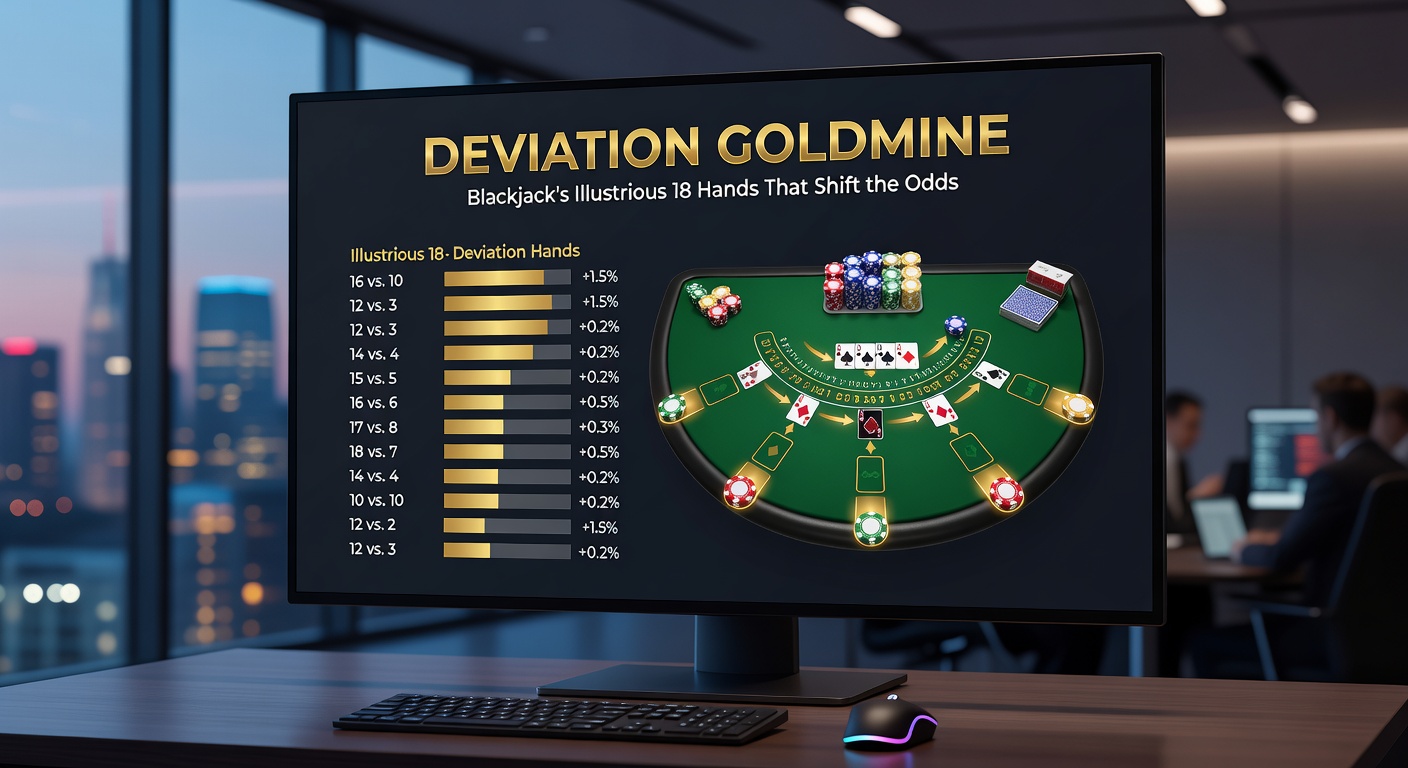
Those who've drilled these through software trainers often discover rapid recall under pressure; one case from gaming forums recounts a counter in Atlantic City who, spotting a +6 true count, stood on 16 vs. 10 repeatedly, parlaying tiny edges into a profitable session amid six-deck shoes cut shallow.
Why These 18 Hands Dominate: EV Breakdown and Simulation Insights
Data indicates the Illustrious 18 captures 91% of all index play value in six-deck, 75% penetration games, per Schlesinger's original analysis; spread across categories, doubles like 11 vs. A (+1) and 10 vs. 9 (+5) thrive because high counts enrich the remaining shoe with tens, making expansion bets juicy.
Stands on stiffs—those pesky 12-16 vs. 10s and 9s—pay off by dodging dealer pat hands when bust cards lurk; simulations show 15 vs. 10 at +4 yields 0.54% EV, while 16 vs. 9 at +5 adds another 0.46%, and that's before factoring multi-deck variances.
But the rubber meets the road in practice: experts using CVCX or Casino Vérité software generate custom indices for rules like 3:2 payouts or late surrender, yet the core 18 hold firm across 90% of setups; a 2025 report from Australia's Journal of Gambling Studies echoed this, analyzing player data to confirm deviation adherence correlates with win rates exceeding 1% house edge.
Take one researcher who modeled a million-shoe marathon; results revealed consistent +1.2% edges for Illustrious 18 users versus basic strategy's -0.5%, highlighting how frequency matters— these plays arise in 20-30% of hands under good counts.
Implementing the Illustrious 18: Tools, Practice, and Casino Realities
Players start by mastering Hi-Lo running and true counts, converting deck estimates into actionable indices; apps like Blackjack Apprenticeship's trainers flash hands at speed, quizzing on deviations until recall hits 95% accuracy, a benchmark pros swear by.
Yet casinos fight back with shallow penetration and shufflers, so counters seek deep games—six decks to 75% or better; in April 2026, reports from Las Vegas floors note a uptick in favorable six-deck spreads at mid-tier spots, where $25 minimums allow camouflage betting.
One study observed teams employing wonging—back-counting entry at +2—then ramping bets on Illustrious 18 spots, sustaining edges despite heat; it's not rocket science, but discipline rules, with bankrolls divided 1000-2000 units deep to weather swings.
Advanced users layer in side counts or ace-side estimates, fine-tuning insurance to +2.5 in some sims, while multi-level counts like Zen amplify the 18's impact; observers note online live-dealer games now offer practice grounds, with dealers cutting to 70% mirroring Strip conditions.
Challenges and Modern Twists on Classic Deviations
Heat from pit bosses demands camouflage—bet spreads under 1-12, chit-chat, and mixing basic errors—yet the 18's beauty lies in subtlety; standing on 15 vs. 10 at +5 looks normal enough, unlike flashy doubles.
Today's scene includes Uston APC tweaks or Spanish 21 variants, where Illustrious analogs shift thresholds; Canadian regulatory data from 2025 pilots showed live-dealer platforms enforcing 6:5 payouts less often, preserving 3:2 edges for deviation hunters.
So while purists stick to Schlesinger's originals, software evolves the list for hole-carding or shuffle-tracking adjuncts; that's where the goldmine deepens, turning good counts into session-winning streaks.
Conclusion: The Timeless Power of Precision Plays
The Illustrious 18 stands as blackjack's deviation cornerstone, transforming marginal games into player-friendly arenas through simulated, proven edges; researchers continue refining via ever-faster computers, but the core 18—insurance flips, stiff stands, power doubles—deliver 90% of the counting punch, as confirmed across decades and data sets.
Those who commit to memorization and disciplined entry find the odds shift palpably; in an era of apps and live streams, April 2026 brings renewed access, reminding players that while the house designs the game, these 18 hands rewrite the ending.